Use Cases
Your Revenue Has a Problem. Here's Where It's Leaking.
AI didn't break your GTM. It revealed what was already broken. These are the patterns we see in every enterprise we diagnose.


Hawksmoor’s AI Search Visibility audit baselined us at 28% Visibility Probability across 32 buyer prompts. We implemented the first two recommendations that same week. Site sessions jumped 38%. AI visibility hit 45%. We logged our second-highest traffic day from ChatGPT within days. That was before we touched the rest of the 180-day roadmap.
The five revenue patterns that show up in every diagnosis.
Revenue Systems That Can’t Scale
You invested in AI tools across marketing, sales, and customer success. Output increased. Revenue didn’t. Signals degrade between teams and nobody owns the full picture.
Buying Committees You Can’t Reach
A single enterprise account can carry 50 to 90 stakeholders across multiple concurrent engagements. Revenue teams consistently reach fewer than 10 of them. The other 40 to 80 are generating signals every week that no one aggregates.
AI Investments That Can’t Show ROI
The tools are live. The dashboards are green. Revenue hasn’t moved. The gap between AI activity and business outcomes is a signal integrity problem.
Engagement That Drops Between Teams
Marketing generates demand. Sales qualifies it. Customer success renews it. Context evaporates at every handoff. Timing drifts. Opportunities die in the gaps.
AI Tools Nobody Uses
Leadership uses AI regularly. Most of the team does not. Training happened once. Daily usage is under 20%. The gap between executive vision and team reality is a people signal, and it’s costing you compounding returns every quarter.
What Changes
What happens when AI is embedded in your GTM strategy, not layered on top.
$2.3B SaaS Platform
The AI tools were live. BDR automation, intent signals, conversational intelligence, AI-generated sequences. Some were producing results. Most were producing activity that never converted to revenue. A few were sitting untouched because teams never adopted them. The GTM strategy was missing. Marketing automation and sales were scoring leads on completely different criteria. The CRM became a dumping ground where two scoring philosophies collided and neither one won.
$600M Fashion Brand
The brand was absent from AI-native shopping assistants where high-value buyers started their searches. AI recommendation engines could not surface product data, editorial content, or client history because none of it was architected for AI retrieval. Sales associates were losing to AI concierge tools that had better context on customer preferences than the brand's own people. The GTM strategy had no answer for a world where AI agents were influencing buyer decisions before a human entered the conversation.
$10B Global Insurance Brokerage
AI tools were deployed to surface cross-sell opportunities and automate renewal workflows. Producers ignored the recommendations because the signals were wrong. The AI could not see the full client relationship across business lines. Renewal predictions fired too late. Leadership had invested heavily in AI-native producer enablement but teams never adopted it. They could not show the board what it produced. The GTM strategy treated each business line as separate when the client relationship was not.
Case studies are illustrative of outcomes achievable with Signal Integrity™. Results vary by engagement scope and client context.
Marketing reports $40M. Sales says $18M is real. The CFO trusts neither.
Marketing reports
Pipeline looks healthy. Leads are being worked.
Sales confirms
Half the contacts are dark or already churned.
CFO trusts
Neither number. Budget conversation collapses.
This is not a forecasting problem. It's a signal architecture problem.
The Day We Killed the MQL.
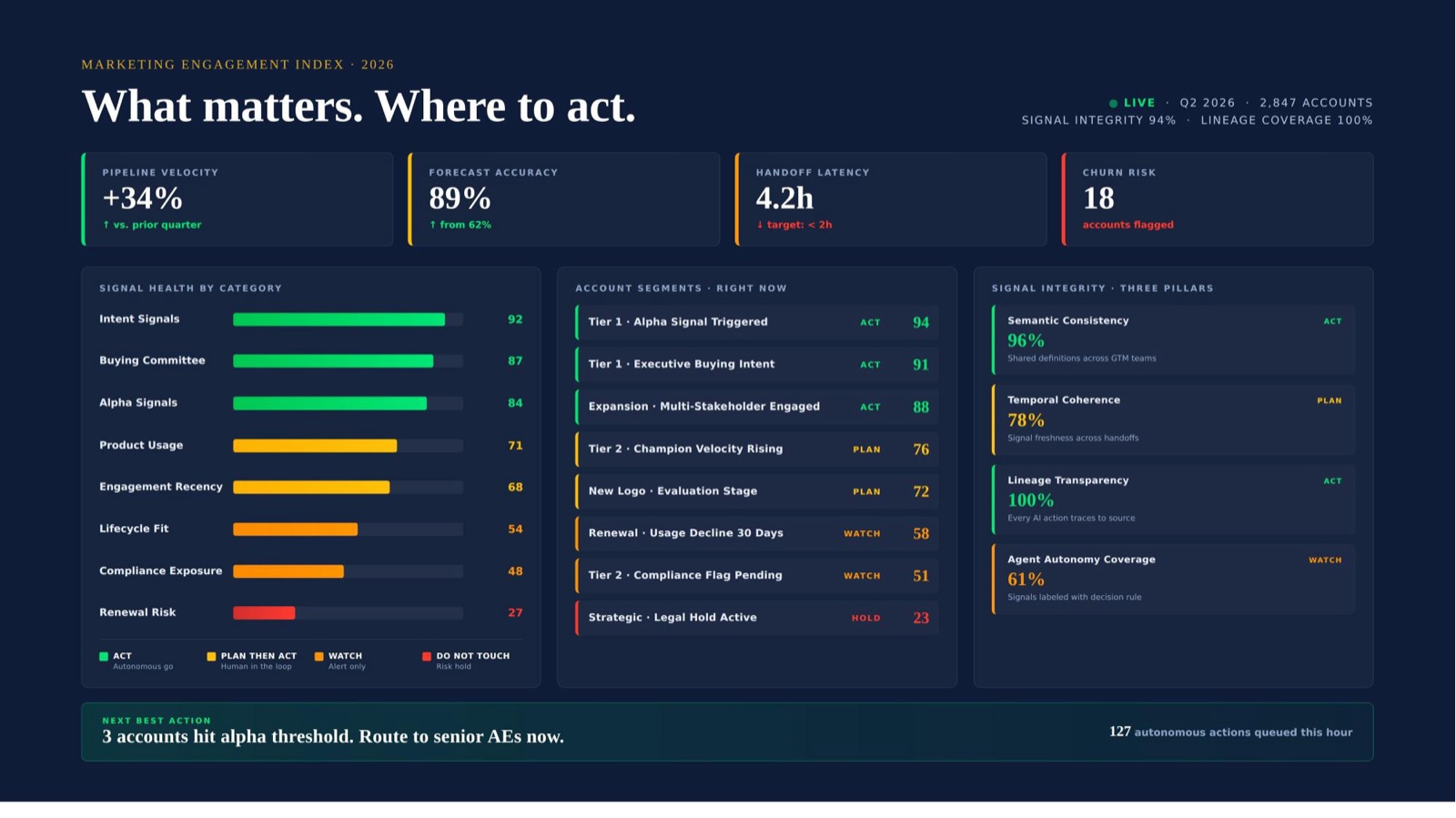
How a $51B commercial cloud business replaced an industry-standard metric with the Marketing Engagement Index, on a single morning, with no warning.
Before Hawksmoor, Lara ran demand for a Fortune 50 commercial cloud business. The team took it from $23B to $51B in revenue. The product was great. The engine underneath ran on Signal Integrity. Eighty signals per account, pulled daily, before AI was even a category.
And it still wasn't enough. One region started missing its number. Lead conversion was dropping and the team caught it every time, but always weeks or months too late. The MQL was the wrong metric. It counted activity instead of intent. Every team defined it differently.
So they killed it. The next morning, nobody across the Americas could see an MQL report anywhere. Marketing couldn't see the count. Sales couldn't pull from it. They replaced it with the Marketing Engagement Index. Account behavior, market timing, and what each account was most likely to buy next, all scored by AI with humans owning the definitions underneath.
“One day, we killed the MQL. There was silence in the hallways for a week.”
Global Demand Center lead. Fortune 50 commercial cloud business.
MEI now ships in every Hawksmoor engagement. Eighty signals became eighty-three. The shift wasn't the number. It was the ones the team added: alpha signals competitors cannot see. Board filing language shifts. Executive LinkedIn velocity. Champion velocity inside the account. Pending compliance exposure. Peer settlement precedent.
These don't come from marketing automation. They come from signal architecture. They're what move markets, not dashboards.
A $300M SaaS company. 22 AI tools. Zero shared definition of intent.
of outbound fired on wrong accounts
Agents routed on stale data. Contacts who had already churned. Twenty-two tools, zero shared intent definition.
Finance called a review. Demand could not explain the scoring logic. The dashboards were green. The pipeline was a fiction.
Marketing didn't fail. Sales didn't fail. The architecture failed them both.
Six signs your architecture is already compounding damage.
If two are true in your company, the architecture is no longer just broken. It's lying to you.
Pipeline mismatch
Marketing and sales pipeline numbers differ by more than 30 percent.
No AI lineage
Your CFO cannot trace a single AI-influenced decision to its source signal.
Semantic drift
Two teams use the word “engaged” and mean different things.
Routing on stale data
Your BDRs are calling accounts that already churned.
Forecast failure
Your forecast accuracy is below 70 percent.
Tool-first buying
You bought AI tools this year without auditing the signal layer first.
These are the specific patterns we diagnose and fix.
The Attribution Collapse
Your MQL-to-revenue math worked for 20 years. Now it's broken. The CFO wants gumball-machine math, but buying isn't linear anymore.
The Scapegoat Trap
Product missed. Sales missed. But somehow it's marketing's fault. Without airtight measurement, you're the scapegoat when the number doesn't close.
The Content Black Hole
You're producing 50 pieces of content a month. Sales uses none of it. You can't tell which content influenced pipeline and which was just noise.
The Signal Swamp
Your CRM is a graveyard of stale data. Your enrichment tools contradict each other. Your AI agents are making decisions based on signals nobody trusts.
The AI Hallucination
Your automated agent just complimented a prospect on a podcast episode they never recorded. Fake hyper-personalization destroys the deal before the rep even knows it happened.
The Pipeline Fantasy
Marketing reports $40M in pipeline. Sales says $18M is real. The CFO trusts neither number. Your pipeline definition includes contacts who downloaded a PDF in 2023.
The Forecast That's Always Wrong
Your board asks for a number. Sales says $45M. Finance says $28M. Neither has been right in three quarters. The problem isn't the reps. Your signals aren't reliable enough to forecast from.
The AI Budget Question
You have AI tool costs spread across 14 line items. The board wants to know what they're producing. You have activity metrics. You don't have a revenue answer.
The CISO Veto
Your AI initiative was approved by the business. Then the CISO asked where the data goes. Then legal asked which systems have access. Three months later, nothing has launched.
When Legal Said No
Legal flagged your AI outreach program. Compliance put your data initiative on hold. Your CISO added three months to your timeline. The initiative stalled before it started.
The Seller Productivity Crisis
Reps are drowning in intent signals they can't trust. They mute the noise and miss the one real deal of the quarter. Your pipeline says one thing. Your close rate says another.
The Demo Agent Disaster
You deployed an AI demo agent to free up seller time. Instead, it pulled the wrong account, leaked competitor data, and killed a deal that was two weeks from close.
The Handoff Graveyard
Marketing generates leads. Sales ignores them. 60% of MQLs are never contacted. The ones that are get a generic email five days late.
The C-Suite Blind Spot
Your firm has six partners talking to the same Fortune 500 client. None of them know what the others discussed. Marketing ran a campaign while sales was in a pricing negotiation.
The Meeting Prep Black Hole
Your reps spend three hours before every enterprise meeting pulling data from five systems. That's not prep. That's a signal architecture problem.
The MQL Credibility Problem
Sales stopped trusting your MQLs. The last 200 converted at 4%. Your scoring model hasn't been updated in two years. Marketing and sales are measuring the same funnel with different rulers.
The Campaign That Moved Nothing
You ran a $400K demand gen campaign. Impressions climbed. Pipeline didn't move. Your attribution model can't connect spend to closed revenue, so you can't answer the CFO's question.
The Handoff That Loses Context
Sales closes the deal and writes a note in the CRM. CS reads it three days later. Half the context is gone. The customer repeats their entire story on the kickoff call. That's when trust starts eroding.
The Personalization Lie
Your marketing automation sends personalized emails based on segments built three quarters ago. Your customer success team is having completely different conversations. The account hears two different stories about your company.
The Enterprise Adoption Gap
The tools were licensed. The training was delivered. Executive sponsors were aligned. Eighteen months later, active daily usage sat at 12%. Adoption doesn't fail at launch. It fails in the months nobody's watching.
The Adoption Cliff
You bought the tools. You ran the training. Ninety days later, half the team is back to the old workflow. AI adoption doesn't fail at the demo. It fails when there's no architecture to sustain behavior change.
The Churn Surprise
Your biggest account just churned and nobody saw it coming. Usage signals were declining for six months. CS was looking at NPS scores instead.
The Expansion Blind Spot
Your installed base is sitting on $20M in upsell potential. CS is too busy firefighting tickets to spot expansion signals. The signals exist. Nobody's reading them.
The Metric That Doesn't Predict Renewal
Your NPS is 72. Your board is thrilled. Your renewal rate is dropping. NPS measures how customers feel about the last interaction. It doesn't tell you whether they'll renew.
The Journey Nobody Owns
Marketing maps the buyer journey. Sales maps the deal cycle. CS maps the onboarding flow. None of them connect. The customer experiences three different companies inside one contract.
The Renewal Scramble
Renewal season hits and your CS team scrambles to build a case for every account in a two-week window. They pull data from four systems. Half of it contradicts the other half.
The Reactivation Blind Spot
You have 600 churned accounts from the last 24 months. You sent them all the same win-back email. Four replied. You have no model for which accounts are recoverable or what message would land.
The Advocacy Gap
Your NPS is 70. Referrals are flat. Satisfied customers don't automatically refer. They need to be identified, activated, and given a reason. You have no system for any of that.
The Reference Program That Doesn't Exist
Your sales team asks CS for customer references two days before a close. CS scrambles to find someone willing to take a call. A formal reference program would have closed that deal three weeks earlier.
The Expansion Story Nobody Tells
Your best expansion accounts share a pattern. Marketing has never documented it. Sales doesn't know it. CS stumbles into expansion by accident. A repeatable expansion motion starts with signal, not luck.
The AI Gap Between Leaders and Teams
Gallup put regular AI use at 67% of leaders and 46% of individual contributors in 2026, inside organizations that had already made the tools available. The gap isn't adoption lag. It's an architecture problem. AI requires reimagining processes, not just automating existing ones. Your teams lack the time, the frameworks, and the strategic roadmap to close the gap.
The Budget That Can't Justify Itself
Marketing owns AI tool spend but can't tie it to revenue. The CFO wants closed-deal numbers, not MQL counts. Every budget cycle becomes a negotiation over credit.
The Positioning That Doesn't Reach Buyers
Messaging is built but sales isn't using it. AI agents surface competitors first. The problem isn't the positioning. It's the distribution architecture.
The ABM Program That Isn't Account-Based
Your ABM platform sends the same content to every contact. Sales needs precision intelligence on 16 named accounts, not spray-and-pray at scale.
The Demand Gen Engine That Creates Noise
Pipeline is up but revenue is flat. The scoring model says one thing, close rates say another. There's no agreed definition of qualified across teams.
The Content That Never Reaches the Buyer
40 pieces a month, sales uses three. Content not architected for AI retrieval is invisible to the systems buyers now use to make decisions.
The Analyst Who Hasn't Heard of You
The category is taking shape. Competitors are in analyst reports. You're not. Presence in AI search and analyst coverage are the same structural problem.
The Win That Marketing Can't Claim
Marketing influenced the deal but attribution can't connect content to contract. Marketing loses budget to functions that show direct revenue lines.
The Launch That Missed the Market
Product shipped but pipeline didn't move. ICP wasn't aligned with who sales was closing. A launch without signal alignment is just an announcement.
The Air Cover That Lands Nowhere
Marketing runs campaigns to thousands. Named reps work 16 accounts. The two motions have nothing to do with each other and neither can prove impact.
The Martech Stack Nobody Owns
14 tools, six overlap, three are obsolete. AI is making decisions on signals from unreconciled systems and nobody owns the architecture.
The Personalization That Isn't Personal
Automation sends emails based on segments from three quarters ago. CS is having different conversations. The account hears two stories from one company.
The AI Content Problem Nobody Talks About
AI content is everywhere. Buyers can't tell the difference. Search engines are deprioritizing it. Volume without signal intelligence creates clutter, not pipeline.
The Category You're Losing
The category is being defined in AI search, analyst reports, and buyer language. If your positioning isn't embedded in those systems, someone else's is.
The Renewal Revenue Nobody Owns
70%+ of revenue is already in the building but nobody is managing it strategically. Signals that predict churn exist, but there's no architecture to act on them.
The Forecast That's Never Right
Sales says $45M, Finance says $28M. The signals feeding the forecast aren't reliable. The forecast is confident, well-formatted fiction.
The New Product That Missed Its Market
Product built, launched, pipeline thin. GTM architecture wasn't built for how the buying committee really works. Signal alignment was never part of the plan.
The Sales and Marketing Divide That Costs Revenue
Marketing runs air cover to thousands. Named reps need precision on 16 accounts. Two motions operate independently and fight over credit for the same deals.
The AI Lawsuit Factory
Banks are flooded with AI-generated arbitration claims. The cost to litigate exceeds the cost to settle. It's a signal architecture problem at the root.
Three metrics that earn finance's trust.
The leaders winning budget right now aren't defending MQLs. They're showing up with a different kind of answer.
Pipeline Signal Quality Score
What percentage of pipeline entries are sourced from verified, consistent, auditable signals. Not how big the pipeline is. How real it is. The answer to a CFO who has stopped trusting the number.
Buyer Journey Visibility Index
What share of your buyer’s actual research and evaluation journey your attribution model can see, including dark channels. Acknowledging the gap honestly earns more trust than pretending last-touch is complete.
AI Attribution Confidence
For each AI-influenced conversion, can you trace the decision logic back to its source signal and explain it. The compliance-ready, audit-ready answer to: why did you spend money on that account.


Hawksmoor showed us how Docgility appeared across AI search and where our go-to-market signals were losing strength. The work turned fragmented customer and market signals into clear priorities we could act on.
Start with clarity. Take the GTM Assessment.
5-minute diagnostic. Instant insights.